In constrained industries — regulated, rules-bound — you can't move fast and break things.
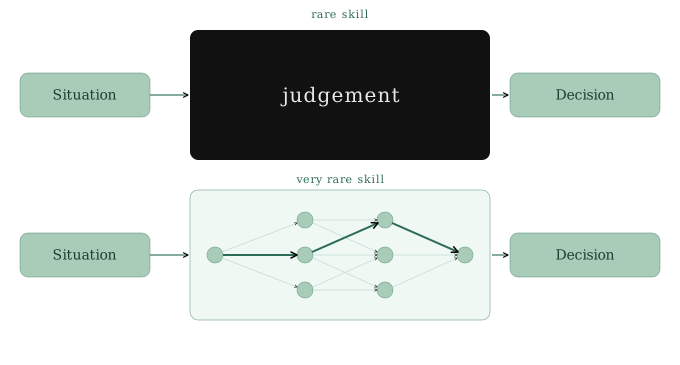
Experience matters. Judgement is prized because it seems like a mysterious black box. I don't know the answer — how do they?
"You are right, Watson, it really is the most preposterous way of settling a dispute."
Holmes has just answered a thought Dr Watson hadn't spoken aloud.
Mysterious.
As Holmes begins to explain, Dr Watson is again amazed. "Do you mean to tell me you read my train of thought from my features?"
I won't spoil your enjoyment of the passage — short story "The Adventure of the Cardboard Box," from the His Last Bow collection — but it concludes, after Holmes has explained step by step, with a final remark from Watson: "…now that you have explained it, I confess I am as amazed as before."
Except that this final remark is Watson at his most credulous. The reality is that the reader, having seen the steps, is no longer amazed. Impressed — but not amazed.
Like Penn and Teller explaining a trick — still impressed,very impressed. But not magic-amazed.
In the same way, judgement is no more than the appropriate manipulation of knowledge and experience. And good judgement is merely an improved manipulation of more knowledge or better-captured experience.
I call it the Hidden Decision Tree. Understanding, in the face of a situation, the questions to put to it — how to rank the significance of the answers, and how to translate the result into action. Or inaction.
A trained eye that knows which things to notice. An understanding of how commercial pressures tend to play out, how similar risks have resolved before, what the regulatory landscape implies here, what this particular signal has meant in the past. Each observation a question the expert knows to ask. Each deduction often an answer experience has already supplied.
"It was very superficial, my dear Watson, I assure you."
Wouldn't it seem so simple if you could write and share some of those decision trees with your colleagues?
But couldn't it magnify the impact you have on your business? Wouldn't it be more valuable — and more impressive — if that was your legacy, rather than judgement calls bounded by the time you personally have to make them?
The one skill more mysterious and valuable than good judgement is the rare ability to surface it — from its hidden decision tree —in a way that allows others to learn it, share it, and deliver on it.